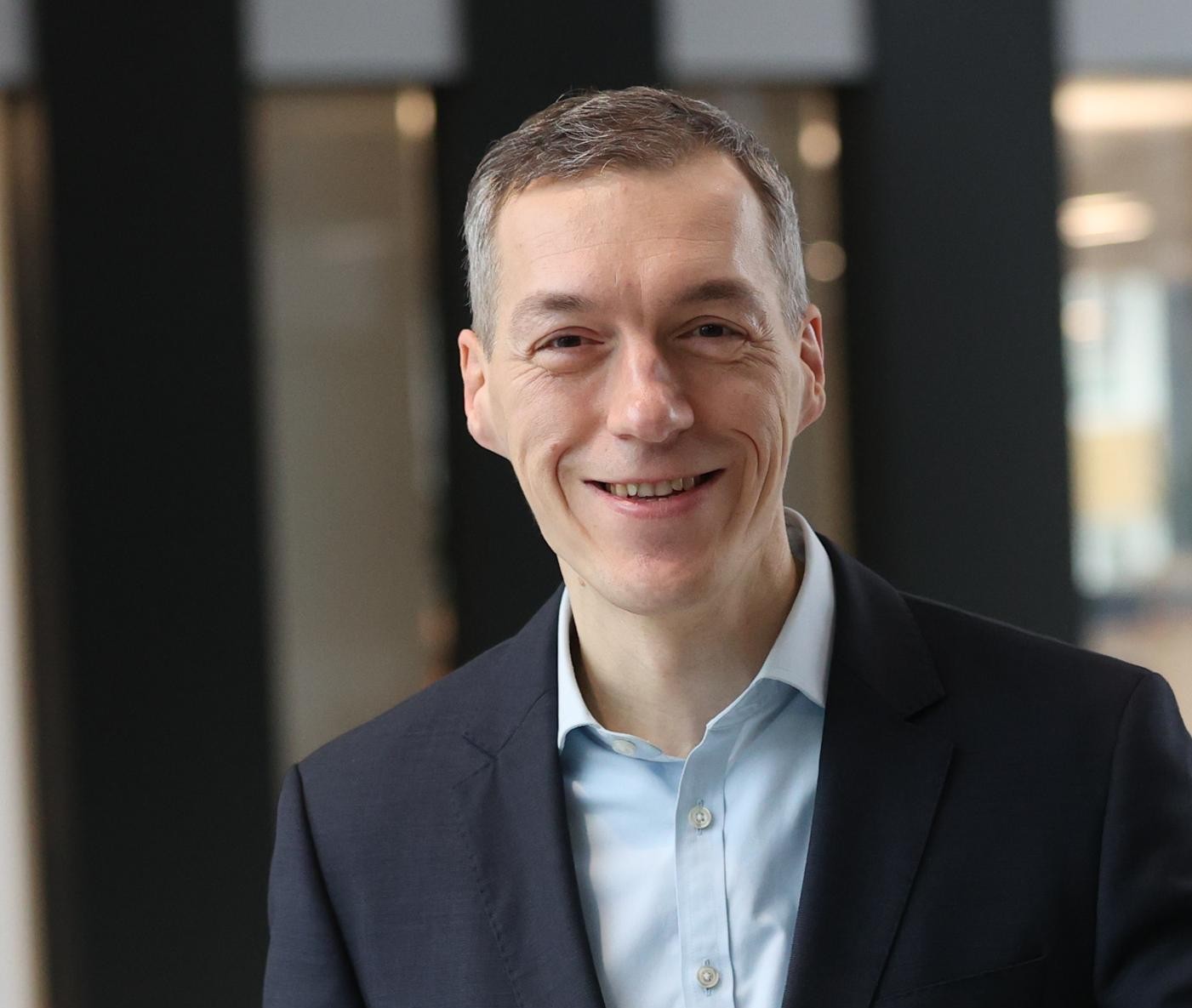
The corporate lead function Information Technology (IT) has been realigning itself since the end of last year. Senior Vice President Christian Hense explains what is changing, why this step fits Freudenberg’s DNA and what it means in concrete terms.
Christian, IT adjusted its organizational structure at the end of 2025. Why was this step necessary?
There has been a significant change in what is expected of IT. While stable systems are still a priority, they are no longer enough on their own. Areas such as digitalization, artificial intelligence and increasing complexity require an IT organization that not only supports value creation but also actively helps shape it. That’s exactly what we are focusing on.
A look at our company’s history also shows that change has never been an exception. It has been the norm. Future viability does not come from standing still, but from systematic continued development. If we did not face up to this change, it would contradict the Freudenberg DNA as well as my own personal understanding of who we are.
What does the realignment mean in specific terms?
For a long time, IT was primarily seen as a reactive service provider. There didn’t seem to be much room to develop value-creating solutions together with the various business units. This model worked as long as market requirements were stable and changes stayed manageable.
Today, our environment is fundamentally different: faster, more complex and more dynamic. At the same time, we also faced certain challenges in our own work practices – ranging from too many simultaneous issues and limited prioritization to a lack of transparency, unclear responsibilities and a form of collaboration that isn’t reaching its full potential yet.
By continuing to improve our organizational structure, we have created an important foundation for changing all of this. But a new structure alone is not enough. The next crucial step is to make even further progress with our work practices and processes.
In what direction should the work practices develop – and how is IT driving this change?
We want to become more agile. To achieve this, we are following a structured approach: Across six iterations, we are working through the key fields of action step by step, regularly reviewing what works and where we need to make adjustments. We have now reached the third iteration. At first, our main priority was to develop a shared understanding: Where do we stand and which specific challenges do we want to address? Building on this, we defined central guidelines: our objective for the agile transformation, the key fields of action and the initial measurable criteria to make the progress and impact transparent.
Now we are focusing on systematically implementing these approaches, embedding them in the teams and constantly developing them further. Learning, feedback and adjustments are integral parts of our approach.
This creates a continuous learning and development process, which enables us to sustainably improve our work practices and solve the challenges we identified.
In addition to the agility you just described, you mentioned prioritization earlier as another determining factor for the future. What exactly do you mean by that?
We are currently facing a large number of requirements – often without clear prioritization. This creates major challenges for us. It means that for us as an organization, it is essential to be more rigorous in assessing what truly moves us forward. This assessment must already take place in the lead centers and be validated across the divisions and by process experts.
For me, the important thing here is a quantifiable business value: Can implementing the requirement make us more efficient, reduce costs or increase revenue? An added factor is that these assumptions must be reviewed once the project has been completed. For us as an organization, this is the only way we can learn which questions we need to ask and which projects are worthwhile in the long term.
Clear prioritization also means increased motivation for our employees. Because when I know that my work will have a positive impact, it has a deeper meaning and I work on my projects in a completely different way.
Another aspect that is closely linked to prioritization is the quality of incoming requests. Unfortunately, they are often not specific enough to be processed directly. This leads to follow-up questions, takes a lot of time and ties up capacities that we actually need for the implementation. That is why we are working with Operational Excellence to address this issue. We are already developing the corresponding processes.
What role does artificial intelligence (AI) play in the transformation of IT?
I see great potential here – not only for more efficient IT processes, but particularly as a real lever for transformation and value creation in our business fields. Our IT organization has many of the skills needed for successful AI initiatives. And I am grateful for a highly motivated team that is ready to break new ground.
For example, we are currently setting up an AI task force that will help us develop and implement automations within IT – with the goal of making these skills available to the entire organization as quickly as possible.
That sounds exciting. For those who are interested, how can they find out what is currently happening in the IT organization and what the new developments are?
You raise an important point. IT is already achieving a great deal – but so far, we haven’t talked about it enough. That is why we are deliberately going a step further. In the future, we want to proactively create even more visibility for our work, the progress we are making and the added value that IT is already creating for FST today. As a result, we will provide more transparency and more opportunities for exchanges – and we are using different formats and channels to do that, depending on the subject and context:
Viva Engage for open exchange, insights into projects, added value and the progress of our transformation – and also to share accomplishments and celebrate them together. It would be great if many employees joined the community, read our posts, discussed them with us and shared their perspectives. [Link to community]
All of our supplementary information is bundled and structured on our SharePoint page for the agile transformation. It ranges from the key objective and fields of action to our iterative approach and specific content on the mindset, work practices and collaboration. [Link to SharePoint page]
Our newsletter (IT Monthly News) offers a feedback option for any general comments, suggestions or topics that employees would like to share with IT anonymously.
And – last but not least – we use our IT ticket tool (Omnitracker) for specific, case-related feedback – for example on ticket processing, service quality or specific IT services.
These different channels are ways to contact us according to the situation and need: in an open exchange or specifically on particular topics.
If we want to be a learning organization, we need to make precisely this feedback visible and usable – in success stories, but also in areas where not everything runs perfectly. It is the only way for us to learn from one another and improve together – because these exchanges are crucial to shaping this transformation successfully together. I invite everyone to actively join us on this journey. Together, we are laying the foundation for collaboration that creates genuine added value for FST.