A new global sourcing process for stamped metal parts aims to increase speed, transparency, and efficiency
Economical sourcing is a key factor in competitiveness. At Freudenberg Sealing Technologies, this is especially true for stamped and formed metal parts, which are used across a wide range of products and therefore offer significant optimization potential.
Deciding whether a stamped metal part should be produced in-house or sourced externally is inherently complex. Costs, technical feasibility, internal production capacities, and lead times all need to be weighed against each other. With more than 13,000 different parts, individual case-by-case assessments – especially when based on inconsistent approaches – led to considerable administrative effort.
“The previous process involved additional loops, tied up significant resources, and therefore caused delays and avoidable extra costs. At the same time, internal manufacturing capabilities within Lead Center Metals were not always fully utilized, and the process lacked transparency,” explains project lead Andreas Pill, Purchasing Manager EU.
The “Sourcing GPS for Stamped Metal Parts” project (GPS = Global Process Standard) addresses exactly these challenges. It introduces a globally standardized sourcing process designed to enable faster, more transparent decisions with less effort. Instead of individual assessments, it provides a clearly defined framework based on three guiding principles: the best possible price-performance ratio based on transparent benchmarks, the efficient use of internal production capacities, and a local-for-local approach. The overarching goal is to further optimize cost efficiency in sourcing stamped metal parts.
Standard or Project? Two Approaches to Make-or-Buy Decisions
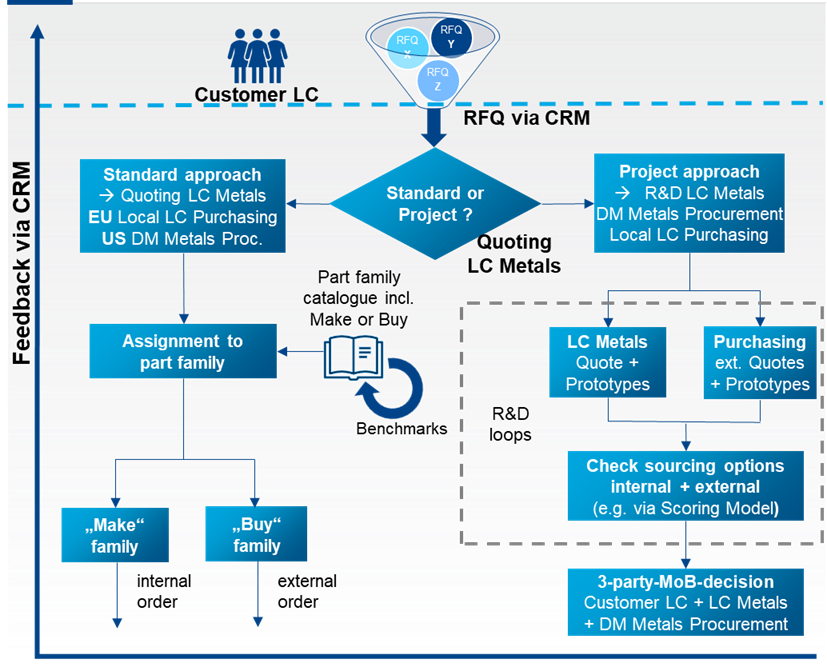
The new process clearly distinguishes between a standard and a project approach.
In standard cases – typically in traditional FST business – the focus is on speed. Based on representative benchmarks, make-or-buy decisions are made for entire part families.
In contrast, projects in the R&D or incubator environment require a more detailed assessment. Technology and supplier scouting, closely aligned with Lead Center Metals and Direct Material Procurement, go hand in hand with a parallel evaluation of internal and external sourcing options.
Part Families as an Organizing Principle
For standard products, the team – comprising members of the Lead Centers and the purchasing organization – has adopted a pragmatic approach: parts with similar characteristics can be evaluated using similar criteria.
Each new standard request is therefore assigned to a clearly defined part family. These families group stamped and deep-drawn parts with comparable geometry, technical complexity, and manufacturability. Based on this classification, the respective customer Lead Center jointly decides how future requests within a part family will be handled – whether the parts are produced in-house (“make”) or sourced externally (“buy”).
Benchmarks for part families serve as the basis for these decisions, using selected metal parts that represent the broader portfolio of each family.
“Grouping parts into families makes the make-or-buy process faster, more structured, and economically more robust through transparent benchmarking,” says Alexander Kubsch, Project Manager at Lead Center Metals. “At the same time, it helps sustainably reduce complexity, risks, and costs by leveraging economies of scale.”
These decisions are not static. They can be reviewed at regular intervals – depending on customer requirements – through benchmark comparisons or cost analyses.
Pilot Groups Tested the New Process
Pilot projects within the Lead Centers Special Sealing Automotive and Heavy Duty have demonstrated that the new sourcing process works in practice, supported by extensive benchmarking comparisons in Europe and the United States.
At Lead Center Special Sealing Automotive, benchmarking within the offset seals part family resulted in clear decisions in favor of in-house production, with measurable cost advantages in both regions. Similar effects were observed in Lead Center Heavy Duty, where seven out of nine part families were assessed as economically viable for internal production.
In addition to cost benefits, participants highlighted shorter quotation times, reduced coordination efforts, and significantly greater transparency in decision-making.
“With this project, we are bringing structure to a complex topic and now benefit from a shared decision-making framework that is transparent and easy to follow. While this requires some initial effort, it makes us significantly faster and more efficient in the medium to long term,” says Pill.
Giorgio Cucco, who oversaw the pilot project for Lead Center Heavy Duty in Luserna, adds: “Communication has improved noticeably. Strategies are more closely aligned, and financial flexibility can be used more effectively. From the Lead Center’s perspective, the pilot was a clear success.”
Rollout to Additional Divisions Underway
The process is now mapped in Signavio and supported by CRM documentation.
Next steps include refining global part family definitions, providing process and CRM training, and rolling out the approach to additional divisions. Implementation is currently underway in the Dynamic Sealing and Static Sealing divisions, followed by Special Sealing and Fluid Power. The rollout is expected to be completed by early 2027.