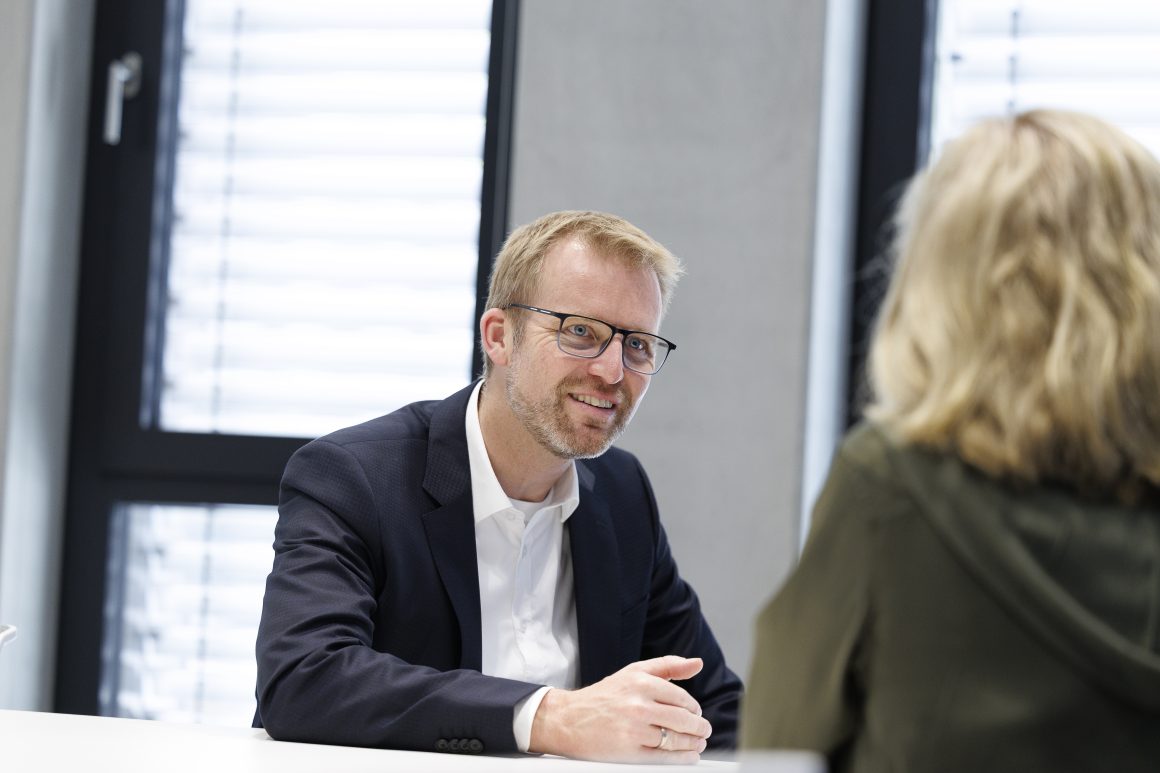
O-Ringe und Gaskets für O-rings and gaskets for new business areas in batteries and electrolysers, seals for computer chips, humanoid robots, and, as always, for the traditional automotive industry: The Static Sealing Division is in the midst of a transformation. In this interview, Division Head Malte Mueller explains why traditional products are needed in high-tech applications – and why speed, automation, and material expertise will determine tomorrow’s competitiveness.
Malte, when people think of seals, “transformation” isn’t necessarily the first thing that comes to mind. What makes the business more exciting and forward-looking today than it might appear from the outside?
We’re in the midst of a major transformation. This is closely linked to the automotive industry, especially in Europe. While more cars are being built worldwide than ever before, growth is no longer happening in the places it used to. Europe and North America are no longer expanding as they once did, and competitive pressure is increasing at the same time – particularly from China.
For us, that means protecting our internal combustion engine business while also adapting our products for battery-electric applications. O-rings and gaskets are needed there, too. But development cycles are much shorter, the pace is faster, and price pressure continues to rise. In the past, platforms remained relatively stable for many years. Today, customers often come back with the next iteration after just two years. That is exciting, but it also puts tremendous pressure on development, production, and quality.
How is the division responding to that pressure?
Essentially, it comes down to three things: speed, innovation, and cost. For gaskets, we’ve established teams focused specifically on internal combustion engine applications, battery-electric applications, and new industrial products. When it comes to O-rings, our strong materials expertise is a major advantage. We have excellent material development capabilities and can continue to offer cutting-edge sealing materials.
Artificial intelligence is another key driver. We currently have two major AI flagship projects underway in our Lead Centers. For O-rings, the objective is to identify the right elastomer for a specific application more quickly and reliably, based on factors such as the medium, pressure, temperature, and other parameters. In the past, this required Excel spreadsheets, standards, and deep empirical knowledge. Going forward, AI will help support and accelerate that selection process. For gaskets, the aim is to automate product design so that drawings for standardized gaskets can be generated automatically. All of this helps us move faster.
Speed is one thing; costs are another. Where are the biggest opportunities for improvement here?
When it comes to O-rings, we’ve been working for years to manufacture larger volumes more efficiently. If a customer needs millions of parts, it doesn’t make sense to use small molds and many individual presses. We need larger molds, larger presses, and double-deck presses – and we have to master these processes. It’s unacceptable to generate large amounts of scrap or flash, which then require rework. Oberwihl is doing an excellent job here, both in developing and using injection molding and in continuously improving compression molding.
A second major step forward is automated visual inspection. Here, too, we are using AI, including in a program developed by T&I and further refined in collaboration with Static Sealing. With new machinery, we are achieving higher speeds, better throughput, and significantly less pseudo-scrap. The next step is deburring and sorting. This is less about AI and more about good engineering: How can we automate more? How can we eliminate waste from the process? And how can we move away from workflows we have followed simply because “that’s how we’ve always done it”?
What about gaskets?
In that area, we’re often dealing with very large parts – battery gaskets, for example, that can be as big as a table or a door panel, or gaskets for electric motors and gearboxes that are roughly the size of a monitor. With dimensions like these, multi-cavity molds are rarely the answer. The key is to combine machine loading and unloading with automated visual inspection in highly automated cells. That requires excellent, flash-free molds. Here, too, the challenge is to reduce costs, stabilize processes, and strengthen competitiveness.
What growth areas do you see beyond the traditional automotive business?
When it comes to O-rings, we’ve maintained a balanced split between the automotive and industrial sectors for many years. Battery-powered vehicles remain a focus, but we are also strategically expanding our industrial business. One example is aerospace. About 20 years ago, we acquired a plant in Santa Ana and achieved strong growth in the aerospace business there. Now we’re bringing that expertise to Europe as well: We are expanding our manufacturing facility in Castelli Caleppio in northern Italy into our European O-ring aerospace plant. The first audits are already underway.
A second area is semiconductors. Chips are becoming increasingly important – for data centers, for example. They are manufactured in chemically demanding environments that require high-quality O-rings made from FFKM or FKM. Historically, we haven’t been very active in this sector, but we are now building expertise in the U.S. and Europe. Other sectors include agriculture and construction equipment, food and beverage, and energy applications such as switchgear.
Hydrogen is also a major topic. Where does the Static Sealing Division stand in this area?
In the gasket sector, we identified hydrogen early on as a growth area. Initially, we were heavily involved in fuel cells. However, we see electrolysis – that is, the production of hydrogen – as particularly interesting and promising for us at the moment. We are in discussions with leading companies in this field, have products in use, and are continuing to develop solutions together. Technologically, we’re in a very strong position, even though the market is developing more slowly than originally expected.
China will play an important role in electrolysis. The topic is relevant to China’s industrial policy because the country wants to become less dependent on fossil fuels and energy transportation. Like Europe, China is vulnerable to naval blockades, such as the one we are currently seeing in the Strait of Hormuz. We are therefore working closely with our colleagues in China and bringing our technology there. At the same time, it remains to be seen whether hydrogen will be industrialized in Europe or whether development will follow a path similar to solar cells: developed in Europe, but essentially industrialized in China. For us, it’s crucial to be able to operate in both worlds.
You mentioned an H2 Components Incubator. What exactly is being developed there?
The H2 Components Incubator builds on a core competency that emerged from our work on fuel cell systems: membrane coating. Put simply, we purchase membranes and coat them roll to roll. Carbon is applied to one side, followed by platinum. A layer of titanium dioxide with iridium is applied to the other side. Both are very expensive precious metals, but they are needed to efficiently split water into hydrogen and oxygen in the electrolyzer.
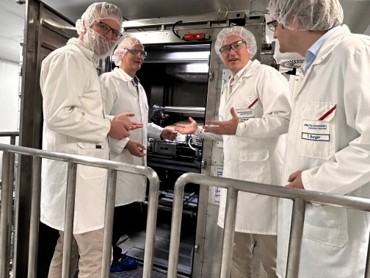
The key point is this: We want to use as little precious metal as possible while maintaining high durability, efficiency, and quality. Our process enables a very uniform, extremely thin distribution of the precious metals. That makes the product more affordable, longer-lasting, and more efficient. We’re still in the development phase, but we plan to provide the first prototypes to customers in September – including test data. If customers’ results confirm our own tests, this could lead to a product with significant added value.
Does the Static Sealing Division also produce parts for humanoid robots?

We’ve been working closely with a humanoid robot manufacturer for some time and are delivering hundreds of prototypes at a rapid pace. It remains to be seen how quickly humanoid robots will gain traction and whether our specific solution will ultimately become established. But it would be negligent not to explore this field. Especially in new applications, it’s important for us to get involved early enough – even if not every project immediately turns into major business.
Another field with great potential is the cooling of high-performance chips. Why are seals needed there?
AI chips generate more and more heat. Over the long term, traditional cooling methods using water and heat sinks may not always be sufficient. In certain applications, liquid metal is therefore used because it conducts heat particularly well. However, this material must not leak, so a reliable seal is needed. Here, too, we are in discussions with major manufacturers. This clearly shows how traditional sealing expertise is becoming relevant in entirely new applications.
What role does North America play in this transformation?
North America is different in some respects because the market there is shifting toward battery-electric vehicles less rapidly than in Europe. At the same time, we’re benefiting there from technologies we developed under competitive pressure in Europe. Thanks to new molding technologies, we can now manufacture O-rings more efficiently and gain market share even in traditional internal combustion engines – a segment that was previously out of reach for us. So what emerged in Europe as a result of cost pressure is helping us become stronger in our traditional business in North America.
The acquisition of Alto – now known as the Application Center Friction Technologies – added a new business segment. To what extent does this fit with Static Sealing?
We list Alto as the Application Center (AC) for Friction Technologies. It focuses on friction discs, not traditional sealing products. Friction discs are used, for example, in automatic transmissions: metal discs and friction discs are arranged side by side in stacks and use friction to engage a gear. For us, this is particularly interesting in the aftermarket; that is, we manufacture for Corteco, of which TransTec is a part. With TransTec, we have a strong brand in North America, but until now we have primarily been able to offer seal kits. Thanks to AC Friction Technologies, we can now offer complete maintenance kits – that is, seal kits and friction discs from a single source.
The sales synergies are also exciting. Freudenberg has excellent access to the mobile machinery sector, for example to manufacturers of agricultural and construction equipment. As a company, Alto was too small to be listed by many major customers. With Freudenberg behind us, new doors are opening. One example is friction discs for the parking brakes of large dump trucks. That may sound unspectacular at first, but it is a technical application with considerable potential. We were surprised by how much interest OEMs have shown in friction discs, and we see substantial growth in this area.
China is a crucial market for many automotive suppliers. What does that mean specifically for your division?
Much of the growth in the automotive market is taking place in China. We supply Chinese manufacturers there, but not yet to the extent we could. That is why we are working very closely with our Chinese colleagues. A major issue is the shift in production from traditional compression molding to injection molding. For certain battery applications, we’re talking about enormous volumes – billions of O-rings, if you extrapolate the figures. This cannot be handled efficiently enough using compression molding processes.
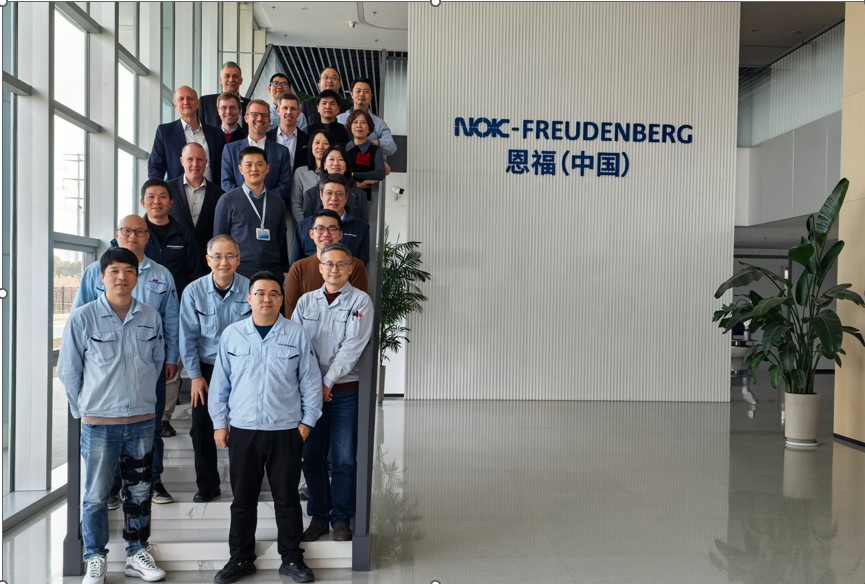
At the same time, we need to be competitive locally. It’s not enough simply to bring expensive machines from Europe to China. We need to transfer our knowledge and work with local teams to develop solutions tailored to the region. It’s challenging, but necessary if we want to succeed in the Chinese market with large-volume projects.
With so many issues to deal with, how do you manage to keep track of everything?
By not centralizing everything or acting as a micromanager. I have a very strong team, and the division is not there to control everything from the top down. We need to identify challenges, allocate resources, build connections, and support the teams. We have strong competence centers, strong regional teams, and many people working very independently on their projects. When needed, issues can be escalated quickly through flat hierarchies. Then we can provide operational support.
What do you see as the key takeaway from all these developments?
We’re under pressure in the traditional automotive business. But we didn’t just start thinking about what we could do differently. We are defending our existing business, working on cost and speed, and at the same time building new fields – from aerospace and semiconductors to hydrogen, mobile machinery, and new applications such as humanoid robots and chip cooling.
The good news is that static sealing products still have many applications in this new world. Our expertise is needed in numerous applications that we have not yet fully addressed. That’s the key point: We must actively shape this transformation, and our products are in a very strong position to do so.
Thank you very much for the interview!