For almost a year, the Weinheim Mixing Plant has been testing and evaluating elastomer compounds during production with a fully automatic measuring system. The equipment was specifically designed for Freudenberg Sealing Technologies (FST).
It all comes down to the mixture. This idea often comes up when the conversation turns to a seal’s performance. To absolutely ensure that elastomer compounds have the right quality, FST’s mixing plant in Weinheim performs spot checks to test and evaluate them.
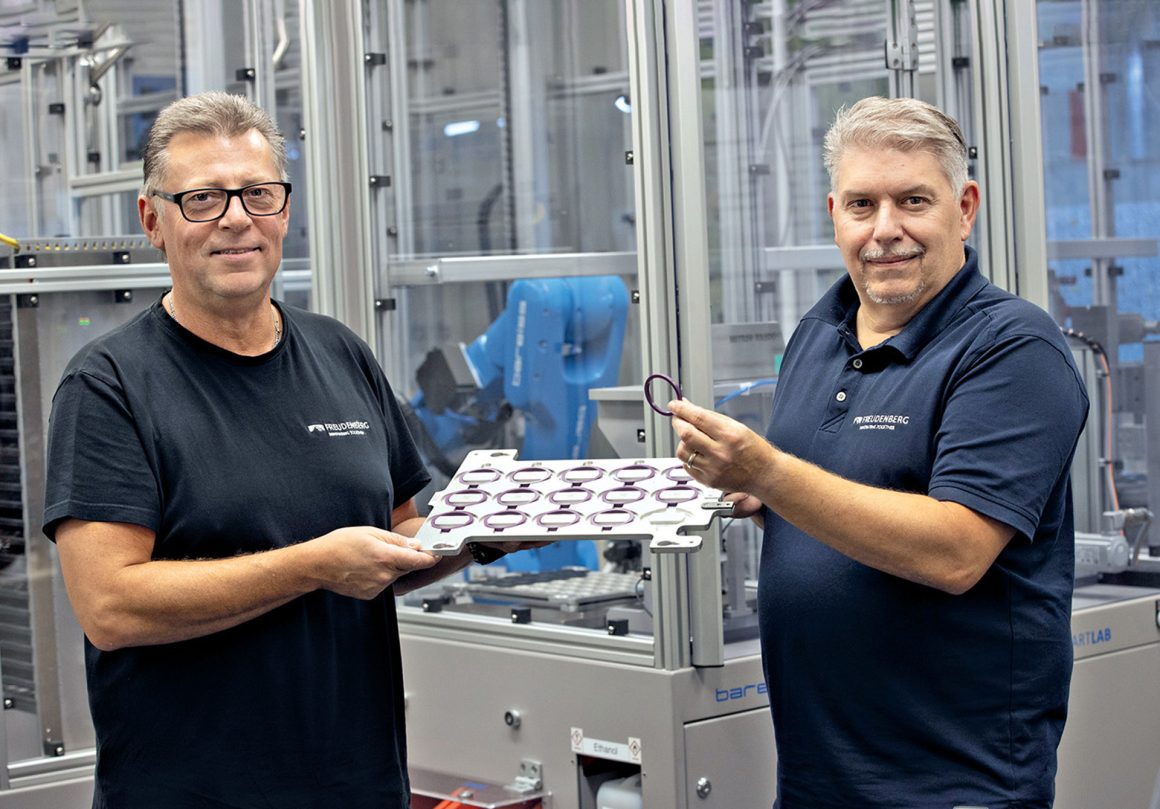
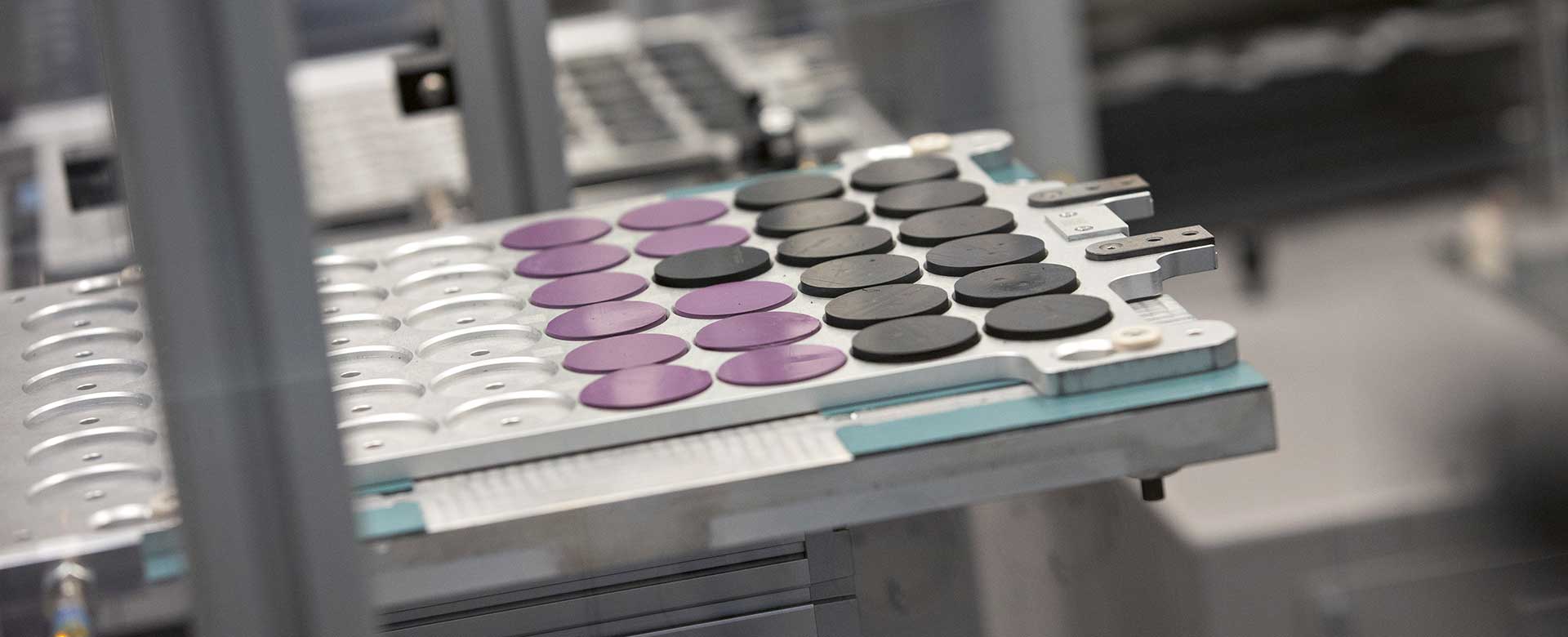
It works like this: To produce the specimens, the employees are committed to processing the material samples with totally conventional approaches, using a rolling mill, punching and stamping machines, presses and post-heating ovens. They are transformed into test pieces in the form of rods, plates or rings in five standardized geometries.
At the mixing plant, the quality program for each individual production order is known as in-process testing. Unlike other work in the testing lab, it doesn’t focus on new developments. It solely involves guaranteeing a constant, uniform compound quality. The actual “acid test” takes place next-door in the so-called smart lab. Here the standardized test pieces are painstakingly tested with state-of-the-art measurement techniques. This means testing for density, hardness, thickness, tensile strength and elongation at break.
FST has invested in fully automatic test equipment to handle this quality-assurance task. Since November 2023, an agile, six-axis industrial robot has been delivering the appropriate test pieces to the measurement stations arranged around it – and doing it automatically. At each measurement station, the robot “serves” the pieces “on a silver platter,” so to speak. These “platters” are known as tableaus. Once all the parts have been gradually removed from them for testing, the robot sets the tableaus down in the unloading station and then carries away the next ones from the tableau station, moving in the opposite direction. All the measurements take place without human intervention and are digitally documented. The system immediately sounds an alert in the event of deviations.
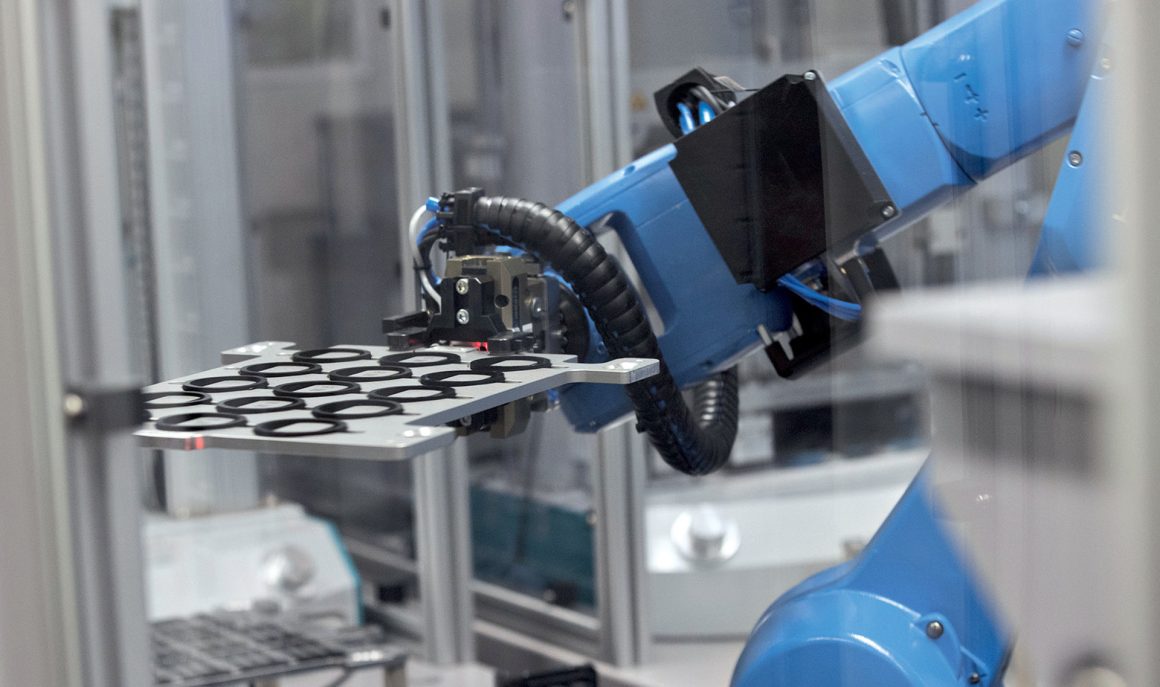
“We can carry out 1,050 tensile tests fully automatically, along with hardness and density tests, 350 in each case,” said Markus Schaab, Quality Manager, Mixing Facilities, Europe. “Ghost shifts” can even be run on the new equipment. In those cases, employees can fill up the tableau station again at the end of the shift. When they go home, the testing simply continues. It is important to note that the precision of the testing devices is checked every day for reliability.
The renowned testing device maker Bareiss partnered with FST on the acquisition. It chose a Kuka industrial robot to work with its test devices in close consultation with FST. After all, precision is not just important for measurement – it is crucial for handling as well. “It is a special-purpose machine designed for us, and you can’t buy it off-the-shelf,” Schaab said. Volker Andolfatto, Testing Technical Center, added: “Together with Bareiss, we quickly cured the “growing pains” and have continued to receive good support.”