Technology & Innovation is developing an AI-supported “Cavity Protection System” for the production of shock absorber seals. Leveraging advanced camera technology to monitor the manufacturing process itself.
Automated Vision Control (AVC) is proving its value at Freudenberg Sealing Technologies (FST) every day, serving as a critical component of the company’s product quality assurance efforts. Traditionally, optical quality control systems focus on inspecting finished parts to ensure product integrity. Now, however, the AVC team within Technology & Innovation (T&I) is taking a new approach: leveraging advanced camera technology to monitor the manufacturing process itself – specifically, the production of shock absorber seals at FST facilities in the United Kingdom, Spain, Turkey, and, in the near future, likely Mexico.
Historically, there have been recurring incidents where shock absorber seals, vulcanized in the press, became stuck in their cavities. If undetected before the next production cycle begins, this can result in damage to the cavity or even the entire tool plate. Such incidents can quickly lead to repair costs in the thousands of dollars, not to mention machine downtime that follows. And these are with no means exceptions. Some sites have reported up to 24 incidents per year in the past.
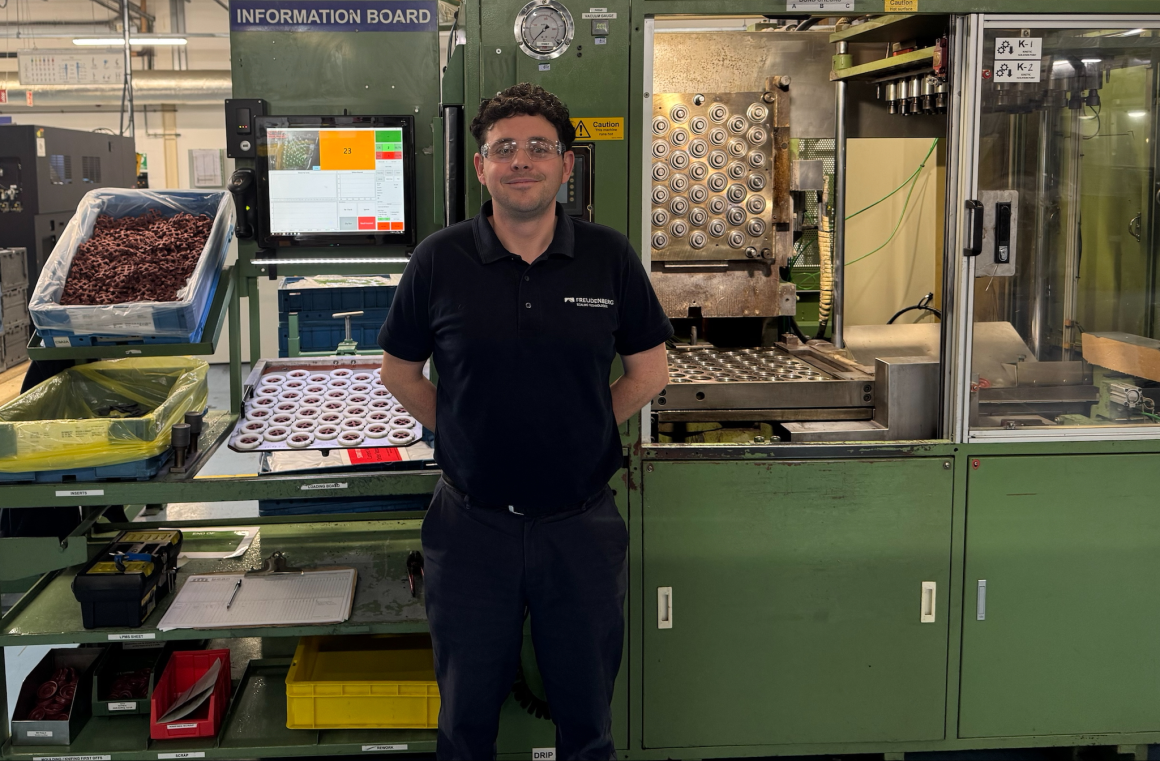
How can production staff be better supported? Under the leadership of Dr. Helmut Hamfeld T&I, the North Shields facility implemented a semi-automated visual inspection system several years ago. Initially relying on classic image processing algorithms – and later enhanced with an early artificial intelligence (AI) model – the system checked after each production cycle to ensure all press cavities were completely emptied. “This approach worked out well and resulted in a significant reduction in press damage,” project manager Dr. Torben Fetzer says, who, along with Hamfeld, forms the AVC team at T&I.
However, there was one major challenge. FST produces a wide range of shock absorber seals using various tools, with some tool plates containing as few as twelve cavities and others as many as 56. For each tool, four reference points had to be set, and the correct reference tool needed to be selected whenever a tool change occurred. This process was time-consuming and prone to error.
Thanks to artificial intelligence, these manual steps are becoming a thing of the past at many European sites. “In collaboration with the Advanced Analytics team at Freudenberg Sealing Technologies (FST), we have developed a universal AI model entirely in-house that operates reliably across dozens of different presses, parts, and layouts,” Fetzer says, describing the new Cavity Protection System. The AI system automatically recognizes and classifies individual cavities, requiring no human intervention. It even calculates the layout of each tool plate, regardless of the camera’s viewing angle.
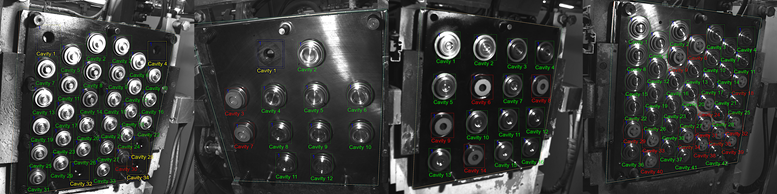
This technology does more than just alert workers when a tool nest isn’t properly emptied. The AI continuously gathers and analyzes data, statistically evaluating the process. For instance, the model can identify cavities that are especially prone to errors. These can then be given special attention or, as a precaution, left empty.
This is continuous process optimization. “With our AI model, we’re increasing process reliability and productivity, while avoiding costly damage and downtime,” Fetzer says. One of the major advantages of the new Cavity Protection System is its flexibility. “It’s very likely that our universal AI model will also be applicable to new parts, or that this can be achieved with only a small amount of additional data,” Fetzer says. The same approach could be extended to other product types beyond shock absorber seals. According to Fetzer, there are many options. Specifically, the system is slated for expansion to approximately 40 additional presses in Spain and Mexico.
At the end of the day, however, it’s not the AI that has the final say on the shop floor – it’s the employees operating the machines. In the rare event of a false alarm, operators can restart the press at their own discretion. These incidents generate valuable data, which the AI uses in subsequent training phases to become even more reliable over time.