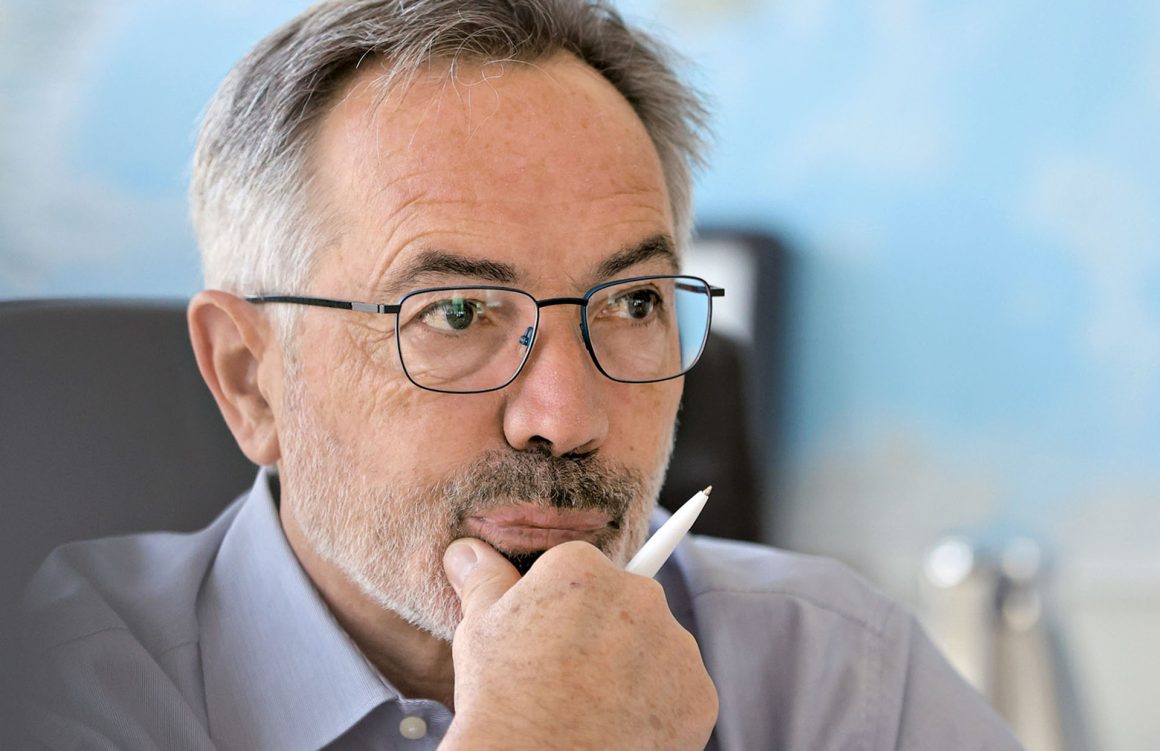
As Chief Financial Officer (CFO), Ludger Neuwinger-Heimes is in charge of finance, information technology (IT) and mergers and acquisitions. In an interview, he talks about the state of digitalization at FST and the opportunities and risks associated with it.
Everyone is talking about digitalization. It is an important part of FST’s corporate strategy. What are you focusing on?
We are pursuing digitalization with a clear objective. The crucial questions are: How can we better serve the customer? How do we improve our internal processes and make them more efficient? Where can we reduce costs? These questions, in relation to digitalization issues, are nothing new. We have been digitalizing for more than 40 years. For example, we introduced an ERP system a long time ago. It allows us to digitally plan and manage staffing and resources such as capital, means of production, materials and so on. In the early 1990s, email made its way into our business lives. Or consider automatic visual controls, which we have been using in production for about 20 years. Over time, the tools have certainly changed, and technological developments have made rapid progress. In modern facilities, the opportunities for analysis in particular are much more refined than they were in the beginning. Today, with the help of artificial intelligence, we can process unbelievably large quantities of data in the shortest possible time. The important part is to interpret and understand the data properly, and then use the information to derive what it means for the customer or our internal efficiency.
Digitalisierung sei alter Wein in neuen Schläuchen, gar reiner Selbstzweck, mutmaßen manche. Wie stehen Sie dazu?
Some suspect that digitalization is old wine in new bottles, or purely an end in itself. What’s your position on that?
Digitalization is not an end in itself at our company. You need to differentiate between the hype and what moves us forward as a company. We have limited resources. So it is essential to evaluate which digitalization tools we should use – and where it makes the most sense to use them. To me, the core task is to set priorities and then really implement them. We must not fall into the trap of thinking everything is great and exciting. We must understand what is helpful to us in the business. We don’t do all the other stuff. The spectrum of opportunities for digitalization is far too wide.
We aren’t pouring old wine into new bottles. Instead, we are using new, improved technologies. But we still have a lot to learn, especially about the analysis of the data we collect. Digitalization also requires new job descriptions. Data analysts are one example. Our employees need new expertise. There are entirely new job profiles. The situation is similar to what you find in electric mobility: Companies used to mainly look for mechanical engineers. Now they want electrical engineers.
What deserves special attention as we digitalize?
We have to see digitalization as a normal issue. We need to draw the conclusions that are right for us. Consider some of the established companies like Kodak. They were once highly successful yet they stumbled and fell. Although Kodak developed a digital camera in the 1970s, it recognized too late that the technology was the future of photography. As the smartphone rose to preeminence, Nokia had a similar experience in its competition with Samsung and other rivals. Mail-order catalogs once arrived at your home by mail, but Amazon quickly dominated the business. Customers began ordering their merchandise via the Internet.
What opportunities – the key ideas here are efficiency, productivity and quality – does digitalization offer FST?
We are becoming more productive. We are seeing less variance in our products. That is giving us higher and more reliable quality. And if something goes wrong, we discover the problem more quickly when we have digital processes at our disposal. We can clearly see this in our mixing plants, to cite one example. The same thing applies here: The more data and information we have, and the less variation that our raw materials and processes have, the less variation in the end-product.
The key point for our employees: If robots or cobots handle boring or physically demanding tasks, for example, people can do more challenging and less monotonous work. For nearly 25 years, we have been using robots in the production area at our Pinerolo plant. They were once expensive and highly complex. Today we are seeing an outright collapse in the prices for robots. There are also simpler units now, and they carry out simpler tasks. That makes it easier to justify the investments.
So FST has charted the right course?
Certainly, but we have also made mistakes, for example, when we developed a digital platform that customers did not accept. Today we have digital product catalogs and offer the opportunity to make digital purchases via the EASY platform. The fact is that every digitalization issue involves a great deal of work, and the return is far off in the future. FST is ready to put its faith in digitalization if it benefits our customers and our internal processes.
What new challenges and risks for FST are emerging from the digitalization trend?
For one thing, we are placing a highest possible value on data security. In recent years, hackers have drastically increased their cyber attacks. On one hand, sensitive data can be stolen. On the other, companies can be completely crippled and extorted for ransom. Even Internet giants like Yahoo and Microsoft are not immune to these attacks. Just in the last five months, Microsoft says it has been the victim of hacker attacks in more than 42 countries.
Beyond that, issues of process security naturally arise. Could a robot theoretically be hacked and manipulated from outside the facility? Could this damage production? I’ll say this again: Cyber criminality poses real risks to companies. We have to take data protection seriously, and we can’t get involved with gimmicks.
What problems are FST’s digital teams working on right now?
Our teams work in many different areas simultaneously. One of them is the “Ready” project, which relates to plant infrastructure. In the past, it was just electricity that was mainly needed for smooth manufacturing operations. But WLAN connections have suddenly become indispensable, along with bandwidth, stable networks, the right connectors and so on.
We now have a new level of transparency. This helps us handle problems with material procurement, for example. In data processing, we have reached a new level. We can capture and evaluate huge quantities of data in a very short time. At the same time, external partners such as Celonis are offering digital tools and assistance with their use. Our customers benefit from this. It is improving our understanding of their planning, and we can communicate with our suppliers more easily.
How do you set your priorities? What criteria do you use?
We choose an approach based on the business: Representatives of corporate management, the divisions, the corporate lead functions and sales sit down together. We examine the problem that we need to solve and the tools available to us. Not the reverse approach, which is based on the idea that “we have a great tool, and now we are looking for the right problem for it.” This should have nothing to do with an infatuation with a technology. As with our lean toolboxes, we need just a few, powerful tools. But we have to master them completely.
What digital tools are you referring to?
We already use a wide variety of digital tools – think about SAP, Customer Relations Management (CRM), Microsoft, Workday for employee development, and so on. We really have to get to know these systems and use them effectively. This doesn’t happen overnight. A system can only function properly if its data are well maintained. Unfortunately, that is often not the case. The simpler the systems are constructed, the more inclined people are to maintain and use them. To put it another way, we don’t want the equivalents of Swiss army knives or flying submarines. We don’t have to adopt every new IT tool available on the market. Instead, it is important to train the organization so everyone is comfortable dealing with the available systems. Even a good carpenter has just a few tools, though they are very good ones. And he masters them completely.
What do increasingly digitalized processes mean for employees?
Many will have to learn new skills, since job content is changing. Analytical skills are becoming more and more important. So is methodological expertise. It is important for people to be able to interpret figures and results accurately. We need an agile workforce that is ready to help the company cope with change. The company’s cultural transformation has long since begun. Digitalization and automation are making many routine tasks superfluous or machines are taking them over. Many people are working differently than they have in the past. The work is often more digital – and less operational.
How long will the transformation take?
A transformation of this kind doesn’t happen overnight. In some cases, the investments are spread out over years. But digitalization is not a project with a firm start and end date. It is more of a continuous process.
How would you sum up FST’s digital activities?
We invest in reasonable possibilities, and we set very precise priorities. It is a matter of what gives the company the greatest advantage, how we can give the customer the most added value, and what most improves our internal processes and makes them more efficient.
Our business drives digitalization. We basically have to understand our problems and find the corresponding solutions to them. So information technology is not the driver. It implements what the business needs.