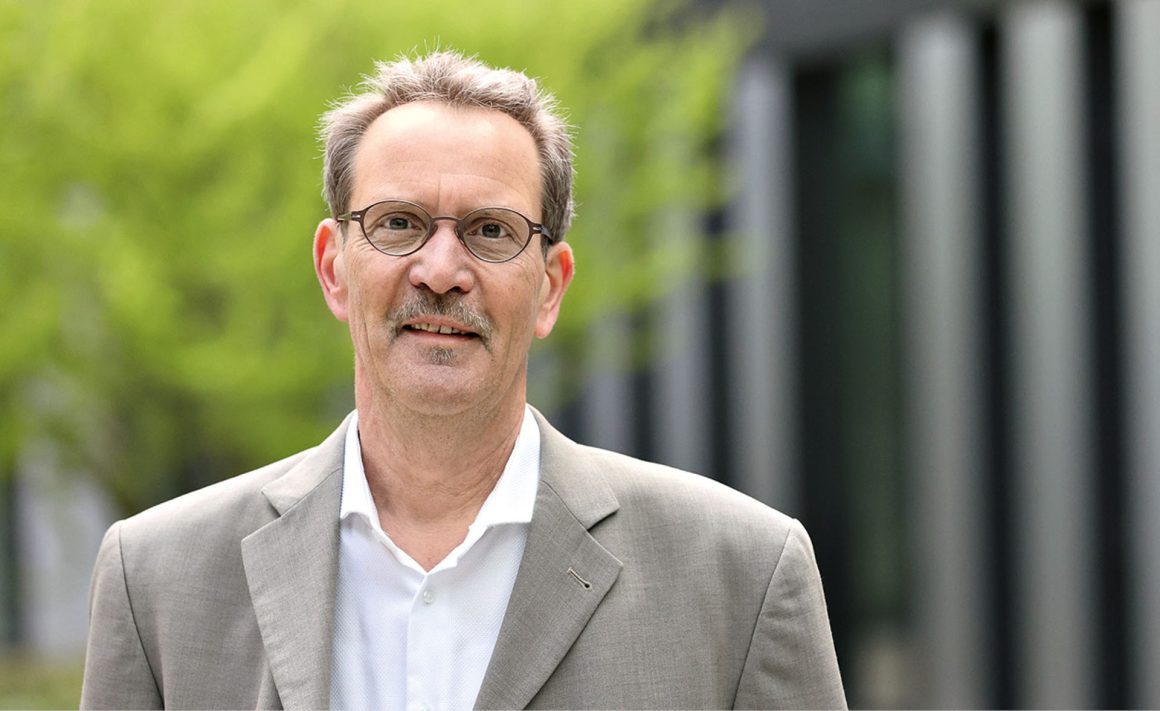
Rudolf Bott, a member of the Freudenberg Sealing Technologies (FST) application specialist team, is building bridges between the automotive and the industrial business. He says both worlds can benefit and learn from one another.
Rudolf Bott knows the automotive business like the back of his hand. At Automotive Sales, he has held a wide variety of management responsibilities. Among other duties, he heads a sales office, and, as a key account manager, he has been responsible for manufacturers (OEMs) and their large (tier) suppliers. He feels at home in both the passenger car and truck businesses. He has also developed new customers and markets in Russia and South Korea.
He has yet to run out of goals in his career. “I’ve really been anxious to do something with electric mobility at this point. I wanted to get involved with pioneering projects. This is an exciting area as FST moves in entirely new directions,” he said. He has been turning his career goal into a reality on the application specialist team at Automotive Sales for a while. He has been supporting Sales and the Lead Centers on technical questions involving new types of powertrains, from batteries to hydrogen all the way to fuel cells.
Bott is charting a new course for himself and for FST’s sales organizations on a team of international experts. Bott deals with automotive as well as industrial applications, with each area representing half his responsibilities. He is a bridge between Automotive Sales and Sales General Industry (GI).
Overlapping Themes
The themes often overlap in one area or another. Like cars, mobile electric appliances, work machines or two-wheeled vehicles all need safe, powerful batteries. New materials for thermal management or other applications in electric powertrains are involved on occasion. “The requirements converge in the high-performance range where the energy densities are high. At Freudenberg, we are familiar with the requirements for individual components and systems. We understand the systemic interrelationships. And we have the expertise to produce large quantities in uniform quality,” Bott said. When the work is coupled with in-depth expertise in materials, it is possible to score points in both worlds.
The auto industry has traditionally been a pioneer on technical trends, and the same is true with electric mobility. “We are trying to adapt newly developed technologies and materials for industrial applications and create special concepts for them,” he said. Solutions developed for automotive purposes are often modified for GI applications. For example, a modified DIAvent pressure equalization valve might be suitable for batteries in other areas of application. Sometimes automotive products are developed further with additional functions. This creates added value through functional integration, by integrating a measurement or cooling function, for example.
In turn, GI is pressing ahead with the use of hydrogen for internal combustion engines and with materials adapted to hydrogen as a fuel. The industrial sector will also drive technologies for electrolysis and the sealing of stationary hydrogen storage systems. In the end, this means both worlds – Automotive and GI – can benefit and learn from one another.