The Lead Center Damper & Steering is turning to 3D printing to make fixtures for its production facilities. It is fast and cuts costs.
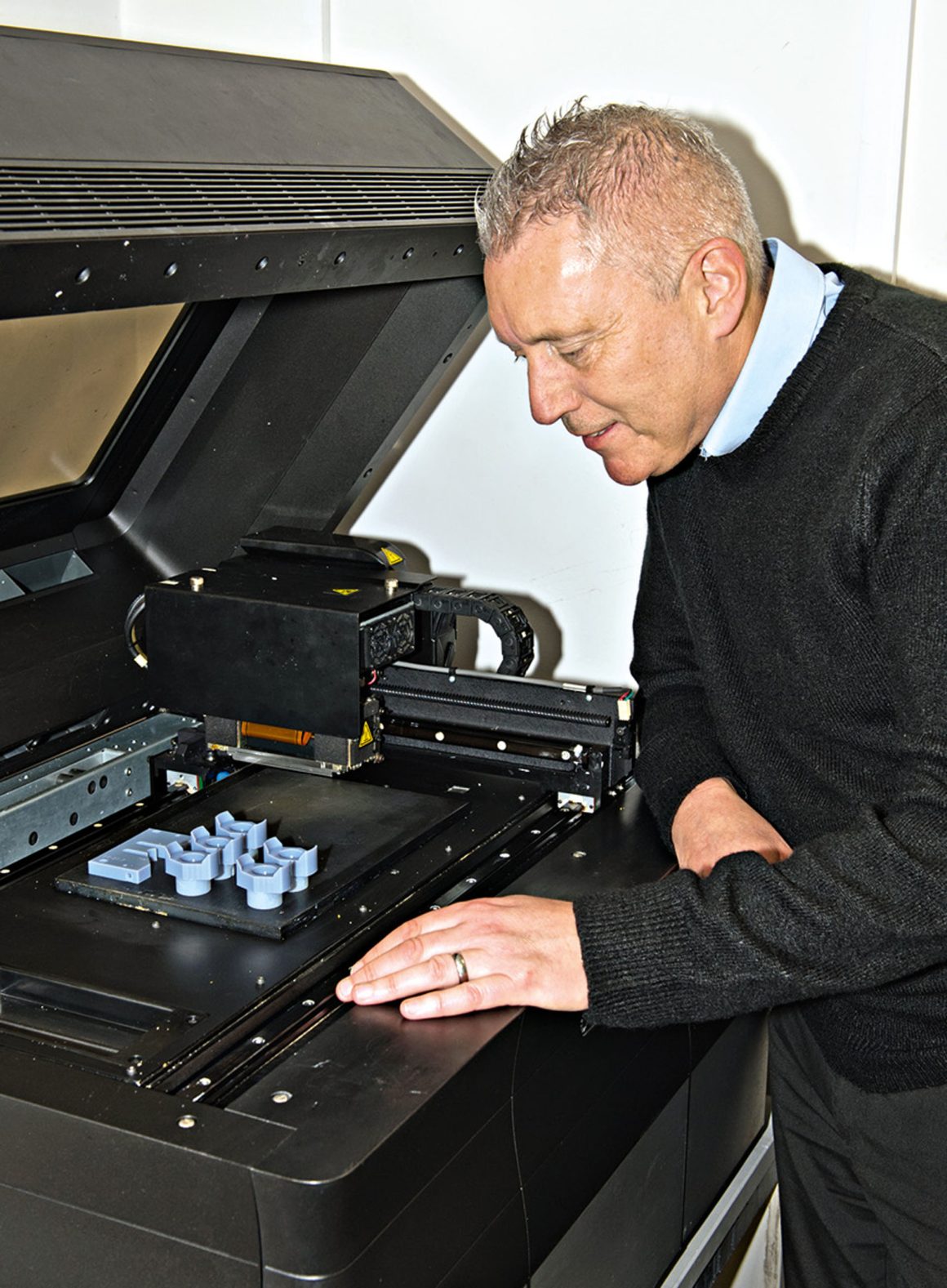
“Every week, as a tool designer, I commission outside contractors to make fixtures for our machines. These machine parts are traditionally made of metal,” said Paul Bowden, Engineering Specialist at the North Shields (England) site of the Lead Center Damper & Steering. The orders are generally for small functional parts such as guides, brackets, grippers, stoppers or protective devices. The lead times for production and delivery are usually long, and it often takes days for the part to be installed. And the prices are high even for small parts.
Bowden had an idea. “We have been using a 3D printer at North Shields since 2015 to produce models of product prototypes. This is the way customers get their first visual impression of a product beyond the design drawings, for example,” he said. “I saw that the device gave us the opportunity to print certain kinds of fixtures that we mainly use in finishing machines, especially for the transport of products and components.”
3D printers have been used at North Shields since 2015 to create models of product prototypes.
No sooner said than done. In 2021, encouraged and confident after the earlier successes, the facility invested in another printer. Without going too deeply into the technical details, the second device uses a different printing process. The first 3D printer builds the models layer-by-layer using liquid polymers and cures them with exposure to ultraviolet light. The second uses a thermoplastic filament to build up one hair-thin layer after another, in a continuous bead made of semi-melted material. The filament then cools down without any additional steps.
The characteristics of the parts vary according to the printing process and the materials used. Some are particularly appealing aesthetically, a feature especially desired in prototypes. Others are more dimensionally stable, robust and durable, making them especially suitable for demanding manufacturing environments. Two aspects are impressive to the same degree: First, the production process for 3D printing takes just a few hours – compared to delivery times of many days, sometimes even weeks, for products from outside suppliers. Second, the material costs are low for both processes.
The idea of cutting costs and reducing lead times hasn’t just impressed people in North Shields. Bowden pointed to the use of 3D printing across the board in the Lead Center Damper & Steering. “We are also producing fixtures and brackets at our plants in Spain and Mexico, and India will soon join them.”
Another example is an entire suction nozzle in Parets del Vallès (Spain). Unlike other parts, it takes a comparatively long time to produce: 12 hours. But keep that in perspective: The delivery time for an outside supplier would be 20 workdays – at nine times the cost of the materials used in the printing process.
“Now in 2023, we are using the same standard equipment in our sites, using the same design standards for the jigs and the same files to produce them. We have the possibility to share files and even print parts for each other if necessary. We regularly share our successes and failures, to learn from each other’s experiences,” Bowden concluded.