A routine production challenge at a Northfield manufacturing cell sparked a broader shift in how Freudenberg Sealing Technologies (FST) approaches automation, efficiency, and operator support on the shop floor. What initially appeared to be a localized issue revealed limitations in aging equipment and pneumatic automation that struggled with consistency and downtime, ultimately affecting overall equipment effectiveness and maintenance demands. Rather than addressing the issue in isolation, the team saw an opportunity to rethink how automation could better support operators and long term process stability.
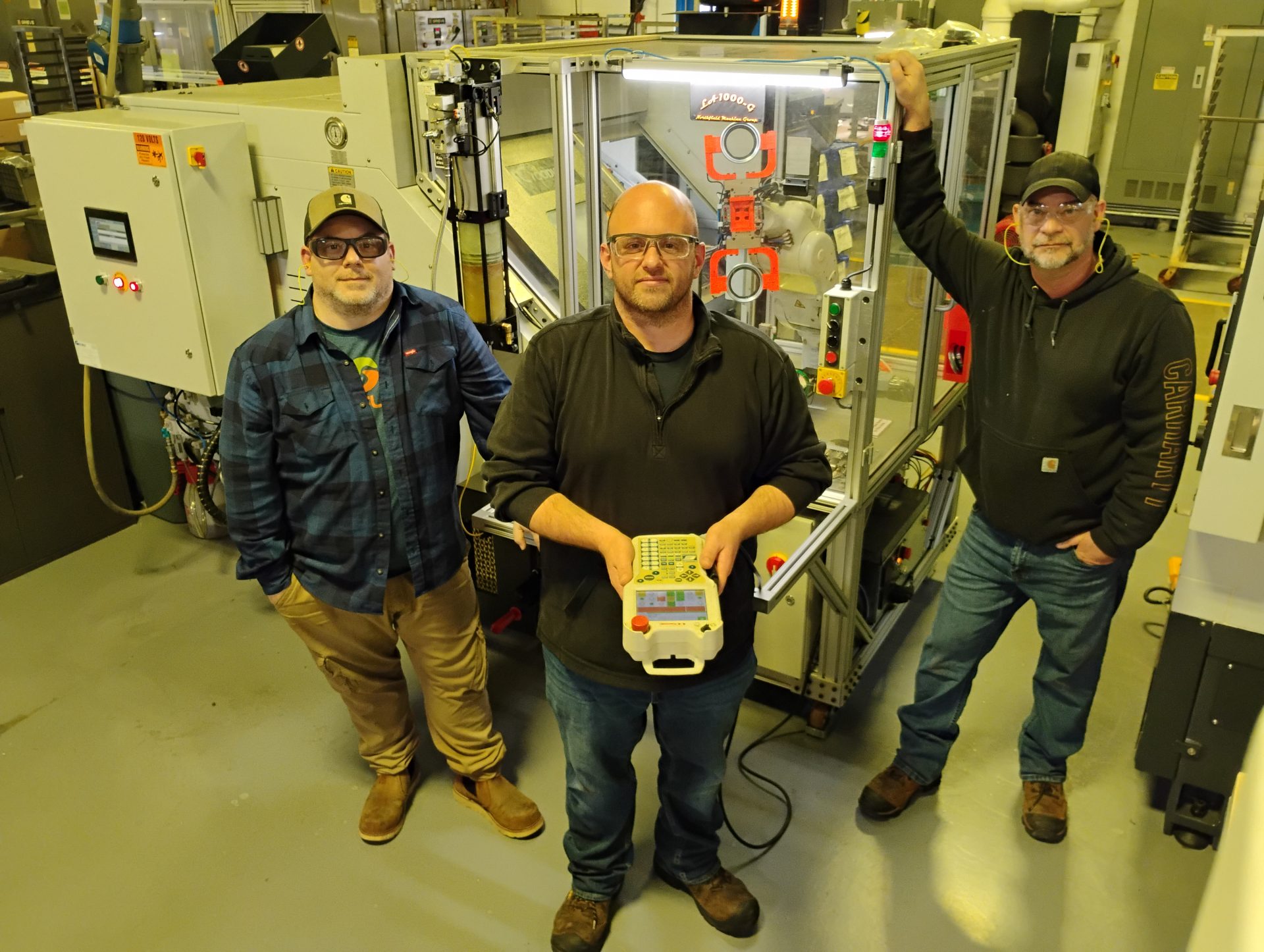
At the center of the effort is a newly integrated robotic system that automates loading, unloading, greasing, and inspection on a Goodway CNC lathe. The automation pairs a Kawasaki RS05 robot with a turret style Goodway lathe using Fanuc controls, a platform already familiar to the team. The robot manages parts throughout machining, applies grease with greater precision and less overspray, and uses camera-based inspection and verification to catch errors before they reach downstream operations, improving both reliability and product consistency.
The project was led by FSTs’ Machine and Automation teams at Northfield. Process Technician Aaron Griebler designed the robotic tooling and programmed the robot, while Automation Engineering Supervisor Simon Barnett developed the CNC programming. “This started with a simple question about whether we could automate the new lathes, and it grew from there,” Griebler said. “Once we began testing different robot configurations and tooling concepts, it became clear we could develop something more stable, more repeatable, and easier for operators to work with.”
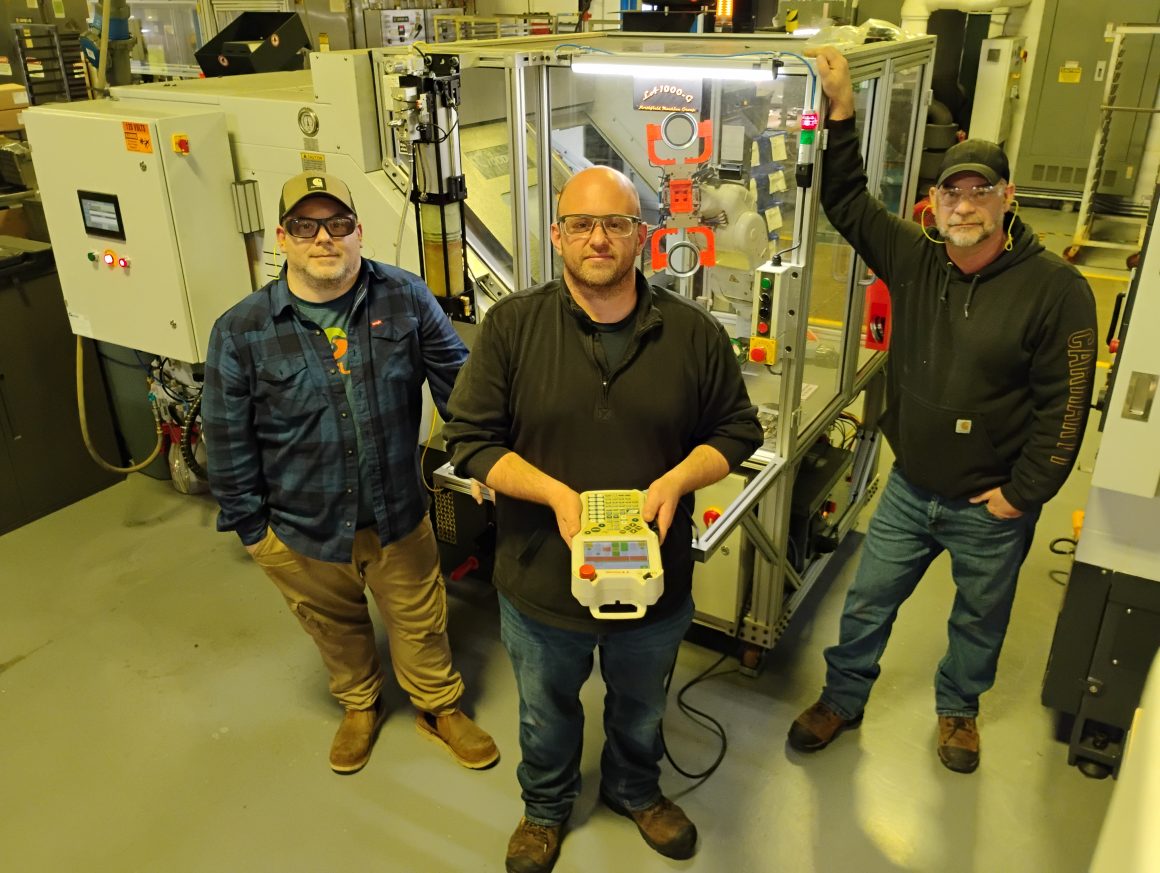
Design work focused heavily on end of arm tooling and robot motion within a compact footprint. Several tooling concepts were modeled and evaluated using 3D printed fixtures before final components were machined and assembled. The automation was ultimately mounted on a rolling platform, improving repeatability and flexibility compared with previous fixed or pneumatic setups.
Beyond replacing aging equipment, the system supports broader operational goals. One operator can oversee two machines, reducing manual handling while maintaining process control. The automated greasing process also lowers grease usage and waste, contributing to improved material efficiency. Early performance results are promising, with cycle time already reduced from roughly 42 seconds per part to about 32 seconds, and further optimization work is underway.
Although the system has not yet been fully deployed to production, early feedback from maintenance and operations teams has been positive. The automation is designed to be straightforward to operate, with complexity handled through programming rather than manual intervention. Looking ahead, the approach developed in Northfield could be applied to other Goodway lathe operations across FST, supporting consistent quality, repeatability, and long-term manufacturing stability at additional sites.