Topics
  • Automotive
  • Corporate Social Responsibility
  • Digitalization
  • Diversity & Inclusion
  • Divisions
  • GI
  • Job Safety
  • Materials
  • Operational Excellence
  • social commitment
  • Strategy
  • Sustainability
  • Technology & Innovations
Categories
  • Archives
  • Competition
  • Customers
  • Events
  • Interview
  • People
  • Short & Sweet
Local
  • Australia
  • Austria
  • Brazil
  • Canada
  • China
  • Czech Republic
  • Estonia
  • Europe
  • France
  • Germany
  • Global
  • Hungary
  • India
  • Italy
  • Lajosmisze
  • Mexico
  • Poland
  • Serbia
  • Spain
  • Switzerland
  • Taicang
  • Tillsonburg
  • Troy
  • Türkiye
  • UK
  • USA
Sealing World Sealing World
Freudenberg Sealing Technologies’ Employee Magazine
  • English
    • Deutsch
    • Español
    • Français
    • Italiano
    • Čeština
    • Eesti
    • Magyar
    • Polski
    • Türkçe
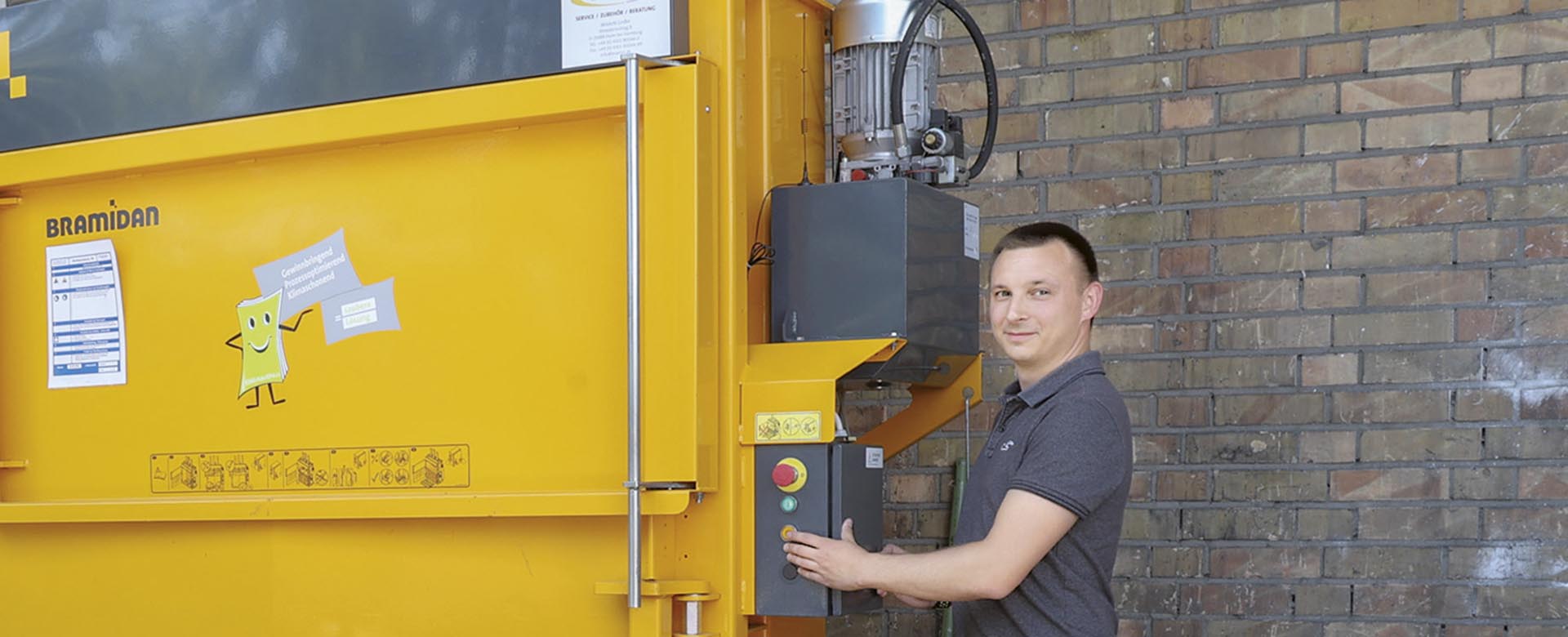
Christopher Stiglmeier, HSE Officer, Mixing Facility Weinheim, an der neu angeschafften Ballenpresse.
  • Sustainability
  • Weinheim

Pressing for Climate Protection

  • 7. September 2022
  • 2 minute read

The mixing plant in Weinheim, Germany, is taking a new ­approach to the recycling of paper, cardboard and paperboard. It makes ­economic sense and is environmentally friendly. In addition, contaminated cloths are now washed instead of discarded.

When waste is recycled, it serves as a so-called secondary raw material for the manufacture of new products. Something old is transformed into something new. Waste becomes a reusable material. The mixing plant is handling recycling even more systematically than it has in the past.

At the mixing plant, it has long been standard practice to separately collect paper and packaging waste (cardboard and paperboard). But now the plant has a new way to do it. Previously the materials ended up in a large waste container that was open on top. As soon as it was filled, a disposal company picked it up and put an empty container in its place. Containers had to be rented, and there was an additional charge for each visit.

Today, when the paper waste is picked up, what had been a container parking space remains unoccupied. The mixing plant has purchased a baling press that compresses large volumes of paper waste into compact bales. Then, totally without the use of a container, the bales are temporarily stored at the parking space. The major advantage: the press greatly compresses the paper and packaging scrap and it takes up much less space.
Christopher Stiglmeier, HSE Officer, Mixing Facility Weinheim, an der neu angeschafften Ballenpresse.
Christopher Stiglmeier, HSE Officer, Weinheim Mixing Facility, at the newly acquired baling press.

Less transport means lower CO2 emissions

Accordingly, in compressed form, more packaging material fits into the parking space than before. The precise amount is 36 bales, each weighing 350 to 400 kilograms (about 770 to 880 pounds). That means the scrap has to be picked up far less often. “We reduced the number of pickups by 80, to 20 percent of what it had been,” said ­Christopher ­Stiglmeier, HSE Officer at the Weinheim ­Mixing Facility.

From an economic perspective, the rent for the container and a large share of the pickup costs are eliminated. “The press is amortized in just a few years,” Stiglmeier said. In terms of sustainability, fewer transport trips mean lower CO2 emissions. The waste contractor also guarantees that the paper will be transported directly to a nearby paper factory – for reuse and not disposal through incineration, which is technically known as thermal recycling.

A word about incineration: Oil-contaminated operating materials generally end up being incinerated as well, particularly cloths used for cleaning at the plant. That has come to an end. The new mission is cleaning instead of burning. A textile services provider now handles this aspect at the plant with the help of reusable cleaning cloths. “There are now 13,000 reusable cloths circulating at the plant. This has allowed us to greatly reduce our hazardous oil-contaminated operating materials to less than one-quarter of the previous amount,” Stiglmeier said.
Similar Topics
  • Edition 04_2022 [EN]
Previous Article
Gruppenfoto BASF und FST
  • Categories

BASF and FST Collaborating

  • 7. September 2022
Read more
Next Article
Osman Öztürk, Jens Bucher und Robert Leins (v. l.) begutachten den neuen Prüfstand.
  • Technology & Innovations
  • Weinheim

More than 1 million Euros for Advanced Testing Equipment

  • 7. September 2022
Read more
The following topics might also interest you
Read more
  • Divisions
  • Divisions
  • Materials
  • Weinheim
  • Weinheim
  • Materials

“We’re Breaking New Ground”

  • 29. September 2026
Read more
  • Global
  • Sustainability

Why Systematic Energy Management Pays Off Twice

  • 2. September 2026
Read more
  • Events
  • Materials
  • Weinheim

A Quantum Leap for Weinheim

  • 20. August 2026
Read more
  • Materials
  • Weinheim

From the Ground Up: Weinheim Builds for the Materials of Tomorrow

  • 20. August 2026
Read more
  • Sustainability
  • Weinheim

Built to Save: How FST’s New Mixing Plant Turns Sustainability into Smart Business

  • 17. August 2026
Read more
  • Weinheim

Redundancy by Design: Securing FST’s Compound Supply

  • 21. July 2026
Read more
  • People
  • Weinheim

Balancing a Future-Shaping Project with Day-to-Day Operations

  • 16. July 2026
Read more
  • Divisions
  • Weinheim

From the Ground Up: Weinheim Builds for the Materials of Tomorrow

  • 13. July 2026
Sealing World Sealing World
  • Imprint
  • Cookies
  • Data Protection Regulations
  • Terms and Conditions
  • California Transparency in Supply Chain Act
Das Magazin für Mitarbeitende von Freudenberg Sealing Technologies

Input your search keywords and press Enter.

  • Deutsch
  • English
  • Español
  • Français
  • Italiano
  • Čeština
  • Eesti
  • Magyar
  • Polski
  • Türkçe