The Talent Acquisition Team ensures that diversity and inclusion are considered during the search for qualified staff.
Freudenberg Sealing Technologies (FST) is zeroing in on yet another area – recruiting – as it promotes diversity throughout the company and develops an organization that reflects the composition of the respective societies where it does business.
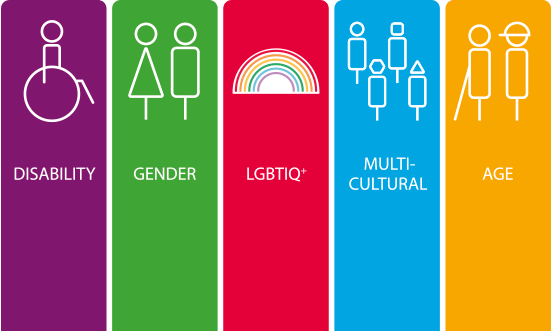
Surveys and studies have repeatedly shown that recruiting in many companies is not neutral, although the bias is often unintended. Job postings are mostly geared to men in the middle or upper social strata. Due to their gender, nationality, religion or a name suggesting a different ethnicity, people miss out again and again. This mostly happens unconsciously, without ill will. Meanwhile, many companies would like a diverse, multicultural workforce that reflects the full spectrum of society.
Freudenberg is explicitly striving for this kind of diversity. The issue of recruiting, that is, the attraction and hiring of talent, is an important component of the current company initiative known as “Diversity & Inclusion (D&I).” During job searches at Freudenberg, every candidate should have an equal opportunity to succeed. Professional qualifications remain the decisive factor in the hiring process and the later career. All applicants should be able to demonstrate their suitability on an equal footing.
Attracting the attention of potential candidates
As early as possible, FST intends to get in touch with universities, associations and institutions and build close relationships long before specific positions have to be filled. The goal is to draw the attention of potential candidates to Freudenberg as an employer and make the application the next logical step. At FST, this challenge has been accepted by Sebrina Hicks (USA), Nicholas Bailey (USA), Lindsay Frasier (GER), Jessica Schmid (GER) and Bikram Oberoi (India). Hicks pointed to an example of how the candidate search can be positioned more broadly and what cooperation with organizations, graduate networks, universities and schools might look like in practical terms: “We have to be there when several thousand graduates of technical degree programs gather at a conference of the National Society of Black Engineers.”
“For example, women have to identify the wide range of career paths in different technical occupations that they can pursue at our company,” Frasier said. “We need to make it even clearer how important diversity is to us and that we are serious about it.”
It is often important to break down barriers. Do the photos used in job postings or publications reflect the company’s diversity? Or consider the next step: Is it constructive to – broad-brushing a bit here – have a young woman of color sitting across from older white men and no one else during a job interview? Is the language gender-appropriate in FST job postings? Do certain words discourage women from applying? Studies show that female applicants often unconsciously associate expressions like “powerful and assertive personality” with men and choose not to apply. In any case, many woman will only apply when they can show that they have all the qualifications mentioned in a job posting. By contrast, men tend to look past a gap in their profile.
In short, there are many different recruiting issues. One is sensitizing managers who conduct interviews to D&I topics and educating them. Interview training is one way to do that. Another is to use training programs to break down traditional thought patterns and potentially reduce the prejudice that many people have internalized unconsciously throughout their lives.
All support for FST’s D&I effort is welcome and essential for the company’s success. Naturally, qualifications and professional suitability are always key criteria in the hiring process. Greater diversity in the candidate pool is the factor that will lead to success. “In our work, we are not just counting on cooperation with the D&I Committee, but on the ideas of all our employees as well,” Frasier said.