Once again, the eight winning teams of the “We all take care!” competition at Freudenberg Sealing Technologies (FST) presented their projects virtually this year. The jury selected one of them to represent FST in the Freudenberg Group’s global competition: the “Fast – Social – Transparent” project submitted by Remagen (Germany). In addition, the FST project “Bionic”@Components from the Weinheim Mixing Facility (Germany) took part as the winner of the Freudenberg-wide category “Occupational Health Management” in the overall competition. The surprise: Both teams won in the final round. For the first time in the history of the competition, four projects were selected as winners with equal standing. In all, 25 FST locations submitted 39 projects to make work safer, to safeguard the health of employees and the environment, and to reflect the company’s commitment to social responsibility.

Corporate Social Responsibility

Environmental Protection, Material and Resource Efficiency

Occupational Health Management
Safety at Work

Site Risks and Emergency Management
Teaming Up Against Child Cancer
CUAUTLA | MEXICO
When children fall ill from cancer, it is a tragedy for them and their families. The situation is even more tragic if they are experiencing financial hardships when the disease strikes. In Mexico, the nonprofit organization Banco de Tapitas collects, stores and recycles all kinds of plastic lids and uses the income to support programs for children suffering from cancer. Freudenberg Sealing Technologies (FST) employees in Cuautla, Mexico, think it‘s a great idea: They have participated in the campaign and have been gathering “tapitas,” which translates as small lids or caps, for the program. In this case, the term refers to the recyclable plastic caps typically found on beverage bottles.
The Banco de Tapitas provides the young patients with support during their cancer treatments. The support can take different forms: gifts of food or clothing, payments for medicines, chemotherapy or transportation, food and lodging or granting a certain wish. Furthermore, the nonprofit wanted to make 200 wigs available for patients who lost their hair due to chemotherapy – and provide accommodations for sick children.
At the Freudenberg Sealing Technologies (FST) plant in Cuautla, the management assembled a team to coordinate involvement in the project. It included the site manager, the HSE manager, the training coordinator, the chief accountant and the plant physician. After employees indicated their willingness to help in a survey, containers were set up for discarded “tapitas.” The participation was massive: 1,000 kilograms (2,200 pounds) of plastic caps landed in the containers and were handed over to the nonprofit.
The support is best calculated by weight: For example, 100 kilograms (220 pounds) of the bottle caps provide three doses of chemotherapy medication Methotrexat. Instead of medicine, the patients may also receive nutritional supplements, tickets for bus travel to the hospital, or overnight accommodations.
And there is more: FST‘s management in Cuautla added to the donation to fund additional chemotherapy, and 15 women at the facility or their relatives sacrificed their long hair for oncological wigs. Another campaign urged employees to register with a stem cell database so they might be able to donate stem cells for children suffering from cancer.
At the Cuautla plant, the initiative struck a chord with employees. They were enthusiastic about the company‘s social commitment and were happy to do their share.

This “We all take care!” project represented FST at the overall Freudenberg competition in May – and won.
Flooding Disaster in Remagen
REMAGEN | GERMANY
Floodwaters literally drowned the landscape of the Ahr Valley last July. After devastating rainfall, the region was nothing like it was before. Over an extremely short period of time, 100 liters of rain per square meter (2 liquid gallons per square foot) transformed once harmless streams into roaring rivers. A total of 130 people lost their lives, and many homes fell victim to masses of water and mud. Sixty employees of Freudenberg Sealing Technologies (FST) were directly or indirectly affected by the disaster, and 35 of them were left with nothing afterwards. While none of the Remagen employees died, help came too late for 12 residents and a caregiver at a Caritas facility for disabled persons, who worked as subcontractors to FST.
The flooding spared the FST plant in Remagen. The only impact on the plant was indirect: a five-week power outage in the region. Employees worked tirelessly to bring the factory back onto the network using emergency electrical generators. They did it in seven days. The plant’s managers had a task force off the ground within a day. Some of them went out to take a look at the surroundings and inspect the damage since neither land lines nor mobile phones were functioning, and nearly all of the roads and bridges were destroyed or blocked.
Others tried for days to find out whether employees and their families, some of whom were cut off from the outside world, were spared. Then the machinery went into action to provide fast help, without red tape, for employees and their neighbors in the region who were affected by the flooding. At lightning speed, resources organized and delivered. FST employees who were not personally affected pitched in to help those in need. Neither the company nor the staff differentiated between their “own” people and others in the region. The help went to anyone who needed it – in keeping with the Freudenberg Guiding Principle of social responsibility and commitment.
FST in Remagen has opened up new prospects for the survivors of the Caritas facility. Since August, many disabled persons have been working at the plant in surroundings designed to give them greater normalcy and structure. In contrast to manufacturing operations, the emergency electric generators were able to get IT, administration, purchasing, sales and development functions up and running in two days. Their staffs made contact with customers, giving them information, asking about their priorities, and preventing as many work stoppages as possible.
The Remagen teams were reassured when customers almost without exception expressed their understanding of the situation and were supportive. There was a lot to do after the plant was back on the grid. To handle the heavy workload, the facility temporarily increased the size of its workforce. The same willingness to help others during the flooding motivated members of the FST family: It was not just external workers who provided the reinforcements. Employees from Reichelsheim, Emmerich and Berlin stepped in to help with accumulator production.
Giving Back to Nature
CHENNAI | INDIA
Freudenberg-NOK (India), a unit of Freudenberg Sealing Technologies (FST), has a plant in Chennai in southern India where a tropical climate prevails. The region is dependent on monsoon rainfall. Even more than in other regions of the world, water is a precious commodity.
The Chennai facility relies on a wastewater treatment unit to process the industrial water used for phosphatization. This helps to conserve water and reduces the operation‘s impact on the environment. Eco Care Engineering, an environmental firm, has certified that the facility‘s purified water is clean enough to drink.
For some time, the Indian site has had a team championing FST’s commitment to corporate social responsibility, or CSR. Its members are actively involved in conserving natural resources and protecting the environment for future generations. The work also includes sensitizing employees to the risks of global warming and jointly taking action against it. The participants consider it important to create eco-friendly spaces around the facility. The cultivation of trees, shrubbery and crops improves the ambient air while creating a natural habitat for insects and birds, and protecting the soil from erosion. And employees get more beautiful and above all greener surroundings.
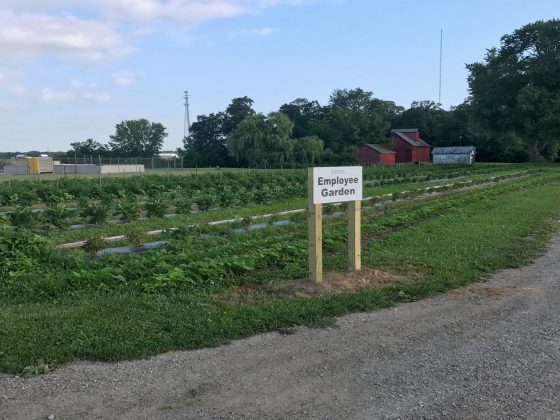
The more than 500 newly planted fruit and vegetable seedlings have had a positive effect on the quality of the soil, and employees now have a fruit and vegetable garden available to them. The cultivation of eggplant, banana trees and okra rounds out the project. Another benefit for employees: Thanks to the greening of the outdoor spaces, temperatures in the production areas can decline by 2 °C (3.6 °F) during the sweltering summer months, making employees’ work conditions more comfortable.
The joy was contagious when the first harvest was counted and weighed. It included 2 kilograms (4.4 pounds) of peas, 126 portions of spinach, 600 bananas, 20 kilograms (44 pounds) of eggplant, 20 kilograms (44 pounds) of okra, 2 kilograms (4.4 pounds) of green beans, 10 kilograms (22 pounds) of tomatoes, and 3 kilograms (6.6 pounds) of green chilis. The entire yield was distributed to employees.
The teams in Chennai did all this on their own. They care for the vegetation and the garden plots – the activities are carried out without additional staffing costs. Employees use the processed water from the wastewater treatment unit to irrigate their plants, and biowaste is used as fertilizer. In short, the people here are giving back to nature.
New Parts Made from Scrap
LUSERNA | ITALY
Steel is needed for the manufacture of many Freudenberg Sealing Technologies products. Its production is extremely energy-intensive – which leads to the massive release of CO2 unless the steel is produced with “green” technologies. Another issue is that steel prices have continually risen in recent years. And like many other primary products, steel becomes a scarce material at times. So there are good reasons to deal with the resource deliberately and economically.
The Application Center Stamping in Luserna has taken on this mission and has accomplished a lot with a good idea. In conventional production processes, metal parts are stamped from a steel band, and so-called scrapped disks in turn come from its center. Until now, remaining material and the scrapped disks went into the metal waste. They are recycled, which, however, costs quite a lot of energy. Want to guess at the amount of waste? A whopping 59 percent of the steel that is used.
In the new process, the punched-out discs are fed back into production to make relatively small parts. The volume of scrap is significantly reduced, and the raw material is used much more efficiently. The actual figures are quite impressive: In just the first four months after the project‘s completion, the facility has recycled 250,000 stamped discs. CO2 emissions from steel production fell 230 tons on a yearly basis. On the other hand, the equipment investment was in the five-figure-euro range and was amortized within six months.
The plan now foresees increasing the number of references produced by this concept and to reach 1.5 million pieces per year, saving 350 tons of carbon dioxide. With this implementation Luserna will save up to 3,100 tons of CO2 by 2030.
An interdisciplinary team took on the challenge, and did not only look at the technical side of the project. Its members used lean manufacturing methods, and were able to cut down on the use of resources while improving changeover times. The presses are now ready to resume operation in 25 minutes instead of more than an hour.
So far, 11 different parts numbers are being manufactured from former waste material using the new process – a total of a million units to this point – but further references will follow. One side effect: The process can be used in other FST stamping plants, making it possible to eliminate even more steel scrap – and carbon dioxide – in the medium-term.
This project prevailed in the “Occupational Health Management” category – becoming another FST winner in the overall Freudenberg competition.
Of Humans and Avatars
WEINHEIM | GERMANY
In recent years, much has been achieved with digitalization at the Freudenberg Sealing Technologies (FST) Mixing Facility in Weinheim. Not least of all, progress in identifying ergonomic risks in the workplace – and helping to reduce the risk of physical strain, prevent muscular-skeletal ailments, and keep people healthy and active longer. It is a win-win situation for the company and its employees.
When employees miss work due to physical strains, the problem often has to do with the musculoskeletal system. That’s why the Mixing Facility in Weinheim is using body sensors in a pilot project to measure and analyze ergonomic movements. The team is gathering insights into the basic uses of sensor-supported movement analysis.
As part of the project, employees volunteer to have sensors attached to their body to record and analyze movements at four different workplaces. The data relating to the movements will be transferred to an avatar. Each movement is stored in numerous individual images so that they can be investigated and evaluated in detail at each relevant position and from different perspectives. “The tool helps our experts in occupational safety,” said Project Manager Bianca Altenkirch. “The comparability of the data ensures the greatest possible objectivity and helps us identify patterns of strain, and draw conclusions about ideal workplace configurations.”
The first findings of the study have already flowed into the reconfiguration of the B-line in Weinheim. For example, the screens needed for the process are no longer arranged one on top of the other, but rather side-by-side, since this leads to less neck strain. The plan for polymer weighing is strictly aligned with ergonomic considerations. The system also helps to determine the best possible movement sequences and trains employees to execute them.
“We can imagine using the sensors holistically and even involving physical therapists and health studios,” Altenkirch said. “This would make it possible to prevent musculoskeletal ailments or, when necessary, target and treat acute complaints.”
“It’s Okay Not to Be Okay!”
WEINHEIM | GERMANY
A full 85 percent of the reasons that people visit physicians can be directly or indirectly traced to stress-related symptoms, according to studies by the World Health Organization (WHO). And 79 percent of employees suffer from work-related stress. For companies, that means that their workers’ stress-related absences are leading to productivity losses. The FST Academy is offering holistic initiatives such as “Science of Health,” along with training on stress management and burnout prevention.
Anja Tunjic und Jason Kohn are Freudenberg Sealing Technologies (FST) employees who work at the FST Academy. In 2016, they started building an internal network focused on stress management and preventative health measures. They want to give employees the opportunity to increase their awareness of psychological and psychosocial illnesses and exchange views and information on the topic. The FST Academy offers material, training, methods, informational videos and e-learning sessions on the company’s Learning Management System (LMS). Interested staff as well as supervisors can sign up for training to acquaint them with the typical warning signals and symptoms of psychological ailments. It also covers how to combat these problems. “Some clear indications of the danger of burnout include sleep disruption, depression, musculoskeletal problems, headaches and tension,” Kohn said.
Tunjic and Kohn launched the “Science of Health” initiative in 2021. It teaches employees how they can stay healthy physically and psychologically. They learn to pay attention to the warning signals from the mind and the body, respond to them quickly and conserve personal energy. The FST Academy has already offered seminars on the topic in Germany, Italy, Austria, Sweden, Czech Republic, United States and Brazil. The initiative’s online presence is due to be expanded so even more countries can be reached. So far, more than a thousand employees have completed training on stress prevention, and more than 100 supervisors have been trained in early burnout recognition. Brochures containing more tips will be available shortly. “The initiative includes different teaching modules on stress, nutrition, yoga, meditation and mindfulness. Furthermore, we are planning to set up a network on health coaching,” Tunjic said. “We want to convey to people that it is absolutely okay if they are not always 100 percent effective in their jobs due to illness. Being ill must not become a taboo subject.”
The Academy has had offerings on burnout coaching and prevention since 2018, and 40 FST employees took advantage of them.
Loading and Unloading – Safely
MILAN | USA
Corteco, a Freudenberg Sealing Technologies (FST) subsidiary, deals in spare parts and maintains a huge distribution center in the U.S. state of Ohio. One of its tasks is the assembly of parts kits. Its activities thus are rather different from those at the company’s manufacturing facilities. Milan has 20 dock locations, and about 35 powered industrial trucks operate on multiple shifts, loading and unloading goods to and from third party carriers. They also move items around in various operations or to store them. As many as 35 vehicles dock in Milan each day. Due to the constant maneuvering, the need to secure trailers, and the coming and going of industrial trucks, the risks differ from those in conventional production facilities, which are now largely forklift-free. During an assessment of risks at Milan, various areas were identified as potentially hazardous. Then solutions were immediately developed.
Many of the loads arriving in Milan – or those picked up at the site – are just partial truck loads. So truck drivers often have to be present during pickups and deliveries to make sure that the right freight is loaded or unloaded. They are immediately given safety vests when they enter the building to increase their visibility to Corteco equipment operators – so they can immediately be identified as visitors and more safely navigate to their designated driver zone. If they don‘t have to be there physically, they have to wait in a safety area away from vehicle traffic.
Another safety issue: Winters in Milan can be very cold and the ground is often icy. That makes it harder to secure trailers with inground methods. By designing a wheel chock that is interlocked with the dock plate with drive-off protection, the site has created a Poke-Yoke solution to secure trailers with drop gates.
Until now, when they arrived at Milan, the drivers drove their trucks up to any loading door they liked. But the docks do not all have the same equipment, and some trailers ended up at less-than-ideal spots for unloading.
Managers in Milan recognized that a technical solution was needed at some of the spaces to eliminate as much of the risk as possible. In part, the answer was to buy electronic safety devices – electronically lockable wheel chocks – then decide which spaces needed them. Signage was posted at appropriately equipped stations and a dock coordinator assigns drivers to dock locations based on the truck’s unique configuration.
Associates in Milan also received training to familiarize them with the new processes and technical aids. They continue to seek further process improvements via the risk assessments and GROWTTH.
A Safer Workplace – Thanks to the DOJO
CHENNAI | INDIA
Each and every movement with an impact on safety needs to be second nature to employees. That‘s why Freudenberg-NOK Private Limited opened a special training center – called the “DOJO” – at its plant in Chennai, India in mid-December. The training is designed to give every employee basic knowledge on the issues of health, occupational safety and environmental protection, commonly referred to as Health, Safety & Environment (HSE).
One of its missions is to sensitize employees to a fact of life in the workplace: It is not merely important to wear personal protective equipment – it is mandatory. Using mannequins and miniatures, the concept vividly shows what can happen when an accident occurs, and employees are not wearing their protective equipment (PPE).
The goal of the DOJO is to train every employee, so each is aware of potential hazards in dealing with machines, forklifts, and dangerous materials. Furthermore, it allows them to manage and continuously improve by understanding the concepts of the incident prevention process. Participants acquaint themselves with the Freudenberg safety standards and learn how to apply them properly. The FST Care app is also being used in Chennai. It makes it possible to report accidents and near-accidents quickly and without any red tape.
One important element of the training plan is to heighten awareness of the natural environment and its protection, for example, by cleaning contaminated water. It is also crucial to reduce the volume of scrap and separate production-related waste. Ultimately, it must be discarded safely and systematically.
Employees not only receive information and training at the DOJO. After the sessions, they must telecast what they understood. They are given an online form containing 15 questions, and they have to answer at least 13 correctly. If they miss too many, they have to go through the training again.
The program‘s managers say the DOJO training offers many advantages over conventional programs. It is interactive, employees are more attentive, and they gain more self-confidence as a result. The success in Chennai is plain to see: No accidents have occurred at the site since the DOJO went into operation.